Ask ten cleaning company owners how they set their prices and you will hear ten answers. Some match the competitor down the road. Some pick a number that feels fair. Some charge by the hour because it is easy. The owners who stay profitable all do the same thing underneath: they know what a visit costs them before they quote it.
This guide shows how to price a cleaning job from your own numbers, with worked examples you can follow. It does not tell you a magic rate per square foot, because that number depends on your wages, your drive times, and your market. If you would rather skip the arithmetic, the free cleaning price calculator does all of this for you.
The short answer
Price equals your direct cost divided by one minus your overhead percent minus your profit percent. Direct cost means labor, payroll taxes, supplies, and travel for that one visit. Overhead and profit are shares of the price, which is why you divide instead of multiplying.
Step 1: work out what the visit costs you
Multiply the number of cleaners by the hours each one is on site, then by their hourly wage. Add payroll taxes and extras, then add supplies and the cost of getting there.
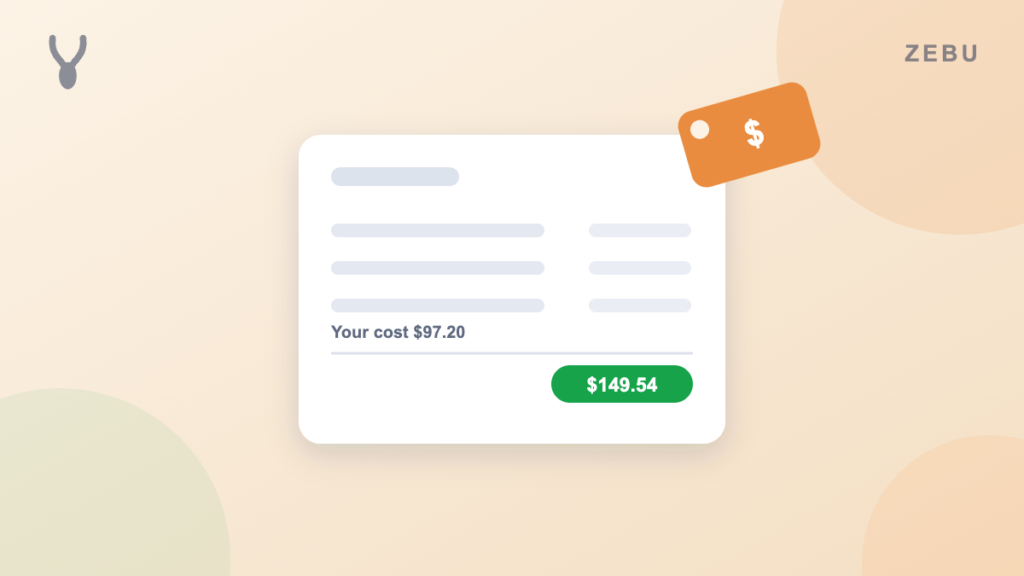
Take a two cleaner visit of two hours each. Wages are $18 an hour with 10 percent added for payroll taxes. That is 2 times 2 times $18 times 1.10, or $79.20 of labor. Add $8 of supplies and $10 of fuel and the visit costs $97.20 to deliver. A price below that loses money before you pay for anything else.
Step 2: add overhead and profit
Overhead is everything that keeps the business running but is not tied to one visit: software, insurance, vehicles, marketing, and your own admin time. Add up a typical month and divide by that month’s revenue to get an overhead percent. Then choose the profit you want as a share of the price.
Say overhead is 15 percent and you want 20 percent profit. Together that is 35 percent of the price, so you divide your cost by 0.65. $97.20 divided by 0.65 is $149.54. Many owners instead add 35 percent to cost and get $131.22. That quote looks close, but it leaves out roughly $18 on every visit, and the gap grows with every job you book.
Step 3: check the price three ways
Turn the same $149.54 into the three numbers clients and crews actually think in:
- Flat rate: $149.54 for the visit.
- Hourly per cleaner: $149.54 divided by four cleaner hours is $37.38 an hour.
- Per square foot: for an 1,800 square foot home it works out to about $0.083 a square foot.
If one of those looks wrong for your market, change your costs or your target. Do not quietly shave the price and hope.
Hourly, flat rate, or per square foot
Hourly is safest when you cannot see the home first or the condition varies a lot. Flat rate is the easiest for a client to approve and pays you more when your crew is fast. Per square foot is a useful sanity check, but square footage alone ignores how dirty the home is, how many bathrooms it has, and whether there are pets. Most owners quote a flat rate and use the other two as a check.
What a recurring discount really costs you
Recurring clients are worth discounting for, but the discount comes out of profit, not cost. Offer 10 percent off that $149.54 visit and the price drops to $134.59. Your cost is still $97.20 and overhead at 15 percent is $20.19, so profit falls from about $29.91 to about $17.20. Your margin goes from 20 percent to about 12.8 percent. That can still be a good trade for a steady client, as long as you chose it on purpose.
Common pricing mistakes
- Counting only the cleaner’s wage and forgetting payroll taxes, supplies, and drive time.
- Adding a percent to cost and calling it margin. They are different, as the markup and margin calculator shows.
- Using one price for every home of the same size, regardless of condition.
- Copying a competitor’s price without knowing their wages, overhead, or crew size.
- Never revisiting prices after wages, fuel, or supplies go up.
Make your pricing repeatable
Pricing from your own costs only helps if every quote actually uses it. A price book keeps your services and prices in one place so every quote, recurring visit, and invoice follows them. If you are choosing software for that, our guide to the best cleaning business software compares six options with real pricing for a five person crew, and the ZenMaid alternatives guide covers the most common switch. You can also see how Zebu works for cleaning companies or review Zebu pricing.
Frequently asked questions
How much should I charge for house cleaning? There is no single right rate. Work out your cost per visit from labor, payroll taxes, supplies, and travel, then add overhead and the profit you want as shares of the price. The free cleaning price calculator does the math from your own numbers.
Is it better to charge by the hour or a flat rate? Hourly protects you when a home is unpredictable. Flat rate is easier for clients to approve and rewards a fast crew. Many owners quote a flat rate and check it against the hourly and per square foot numbers.
What is overhead for a cleaning business? It is everything you pay that is not tied to one visit, such as software, insurance, vehicles, marketing, and admin time. Divide a typical month of those costs by monthly revenue to get your overhead percent.
How do I price recurring cleaning? Price the visit from your costs first, then decide how much of your profit you are willing to give up for a steady client. A 10 percent discount can cut a 20 percent margin to roughly 13 percent, so choose the discount deliberately.
Is there a free cleaning price calculator? Yes. The Cleaning Job Price Calculator is free, needs no account, and shows your price per visit, hourly rate per cleaner, and price per square foot.